

What is a mast stacker and who is it suitable for?
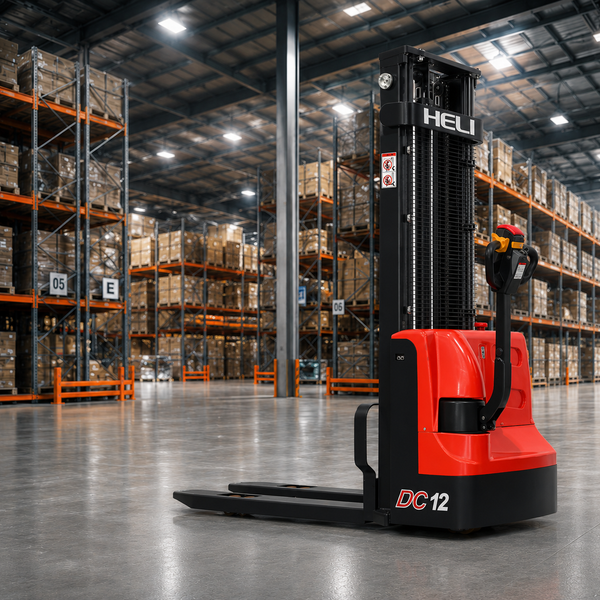
A mast stacker (also known as an electric stacker) is a compact lifting equipment designed for warehouses with narrow aisles and moderate lifting heights—typically between 1,600 mm and 5,500 mm. The operator walks behind the machine or stands on an integrated platform, and the mast lifts the pallet vertically without requiring a massive counterweight.
HandlerKraft markets the main line in this category: the HELI CDD series (1.2T–2.0T lift up to 5,400 mm)—with CURTIS controller and electromagnetic brake.
Ideal user profile:
- Warehouse with working aisle under 2.5 m
- Stacking height up to 4.5–5.4 m
- Loads up to 2,000 kg
- Flat floor, indoors, without ramps or uneven surfaces
- Limited initial budget—a mast stacker costs 2–3× less than an equivalent electric forklift
What is an electric forklift and when does it become necessary?
A counterbalance electric forklift is the benchmark machine for industrial logistics. The operator sits in the cabin, the equipment has 3 or 4 wheels and a rear counterweight that allows it to lift heavy loads to high heights with maximum stability. The HandlerKraft range covers models from 1.5T to 3.5T with lifting heights of up to 7,000 mm.
Ideal user profile:
- Repetitive tasks of 2T+ for the entire shift (8–10 hours)
- Stacking heights over 5 m
- Mixed surfaces: indoors and outdoors on pavement
- Need for rapid mobility over long distances in the warehouse
- Handling non-standard pallets, asymmetrical loads, or bulky goods
Direct comparison: mast stacker vs electric forklift
| Criterion | Mast stacker | Electric forklift |
|---|---|---|
| Maximum capacity | up to 2,000 kg | up to 3,500 kg+ |
| Lifting height | up to 5,500 mm | up to 7,000 mm+ |
| Working aisle width | from 1,800 mm | from 2,800 mm |
| Travel speed | 4–6 km/h | 10–16 km/h |
| Operator comfort | Walk-behind / platform | Ergonomic cabin |
| Purchase price | €3,500 – €9,000 | €14,000 – €35,000 |
| Maintenance cost/year | Low | Medium-high |
| Driving license | Not mandatory | Required (with authorization) |
| Outdoor use | No (flat floor) | Yes (hard pavement) |
The advantages of the mast stacker that many underestimate
The most common mistake we see in Moldovan warehouses is purchasing an electric forklift where a mast stacker would have solved the problem more efficiently and at a quarter of the cost. Here's why it's worth reconsidering:
- Small turning radius—HELI CDD models have a turning radius of 1,300–1,485 mm, making them ideal for Drive-in racks or aisles of 1.8–2.2 m
- No special license required—the operator can be trained in a few hours, without special procedures or external courses
- Suitable for ramps and freight elevators—the low weight (150–700 kg) allows use in elevators where a 3–4 ton forklift would exceed capacity
- Li-ion battery available—HELI CDD15J lithium models charge in 2–3 hours and do not require a separate charging room
- Minimal maintenance—no complex hydraulic system, no transmission, no oil filter—the annual service cost is 60–70% lower than a forklift
Limitations of the mast stacker—what it cannot do
Transparency is essential when choosing industrial equipment. A mast stacker is not the right solution if:
- You work on uneven surfaces, outdoor pavement, or ramps with a slope over 5%
- You need simultaneous lifting of two pallets or special attachments (clamp, rotator)
- The operator performs continuous cycles of 6–8 hours—physical fatigue is significant compared to a forklift cabin
- Working height constantly exceeds 5 m—at high heights, the stability of a triplex mast forklift is clearly superior
- The required capacity regularly exceeds 2T—forcing the load limit drastically shortens the equipment's lifespan
Real scenarios from warehouses in Moldova and Romania
Based on consultations provided to HandlerKraft clients in Chișinău, Iași, and Cluj, we have identified three clear decision patterns:
Scenario 1 — Food warehouse with 4m racks: 800 sqm area, 2.2m aisle, 800–1,200 kg loads, single shift. Recommendation: HELI CDD15J mast stacker. Reason: aisles do not allow a counterbalance forklift, working height is comfortable for a stacker, total cost of ownership over 5 years is 65% lower.
Scenario 2 — Logistics warehouse with 7m racks: 3,000 sqm area, 3.5m aisle, 1,500–2,500 kg loads, two shifts. Recommendation: HELI electric forklift with triplex mast. Reason: height exceeds stacker capacity, workload justifies the investment, operator needs long-term comfort.
Scenario 3 — Mixed warehouse, indoor + yard: Goods reception from TIR in the yard + indoor stacking up to 4m. Recommendation: combination—1 diesel forklift for the outdoor yard + 1 electric mast stacker for indoors. This is the solution we most frequently propose to clients with mixed activity.
Total cost of ownership over 5 years: full calculation
The purchase price represents only 40–50% of the true cost of industrial equipment over its lifespan. Here is a comparative estimate for a single-shift warehouse, 220 working days/year:
| Cost | Mast stacker (1.5T) | Electric forklift (1.5T) |
|---|---|---|
| Acquisition | ~€5,500 | ~€18,000 |
| Battery / replacement (5 years) | ~€800 | ~€3,500 |
| Annual service × 5 | ~€1,500 | ~€6,000 |
| Wear parts (5 years) | ~€600 | ~€2,500 |
| Operator training | ~€0 | ~€400 |
| TOTAL 5 years | ~€8,400 | ~€30,400 |
The difference of €22,000 over 5 years is significant for any business. If your operation's technical specifications allow for the use of a mast stacker, the financial argument is overwhelming.
Conclusion: how to choose correctly in 3 steps
There is no universal answer—there is the right answer for your specific warehouse. Here is the decision-making process we recommend:
- Step 1 — Measure working aisles. Under 2.5 m clear between racks: mast stacker. Over 3 m: electric forklift is feasible.
- Step 2 — Define maximum stacking height. Under 5 m and loads under 2T: mast stacker fully covers the need. Over 5 m or repetitive loads over 2T: electric forklift.
- Step 3 — Calculate intensity of use. Under 4 hours/day of active lifting: mast stacker. Intensive schedule, two shifts, long distances in the warehouse: electric forklift with cabin.
If you have questions or want a recommendation based on your warehouse's exact specifications, the HandlerKraft team offers free consultation—with no purchase obligation. Contact us at +373 22 788-907 or write to us at oferte@handlerkraft.md.