

Why the two categories are often confused
At first glance, a mini loader and a mini excavator look like similar machines — compact, diesel, suited to small sites or tight spaces where a full-size machine wouldn't fit. In reality they do completely different jobs: one moves material on the surface, the other digs below ground level. The confusion costs money — it's not unusual for someone to buy a mini loader planning to dig a foundation, only to discover the machine simply can't do it.
In this guide we analyse both categories using the full HandlerKraft range — 3 mini loader models and 4 mini excavator models — to help you choose correctly for your site or business.
The mini loader: moves, lifts and carries on the surface
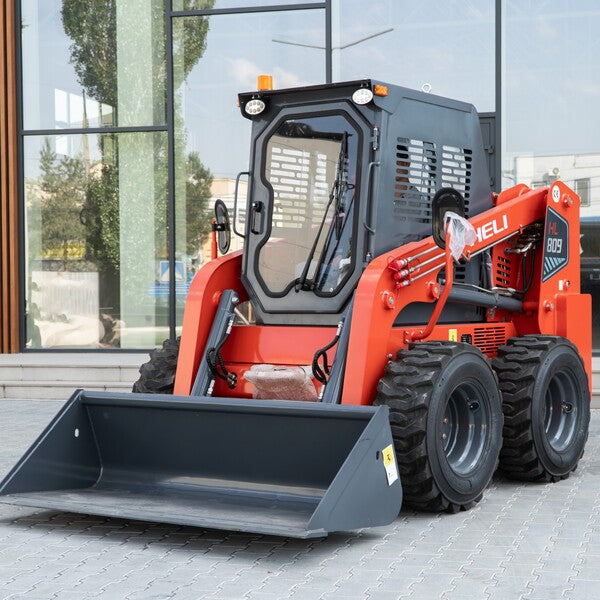
A mini loader is a compact wheeled machine with a rigid frame and skid-steer steering (turning by varying the speed of the left and right wheels), designed to load, lift and carry material — soil, gravel, sand, pallets, snow — over short distances on a site or in a yard. It does not dig below ground level; it is limited to what it can scoop up from the surface.
HandlerKraft mini loader range:
- Mini Loader HL 809 — Quanchai QC498G diesel engine, 45 kW, 0.51 m³ bucket, 45 kN tractive force, max speed 11 km/h — €23,000 (465,060 MDL)
- Mini Loader CDM 312 — Kubota V3600-T-E3B diesel engine, 63 kW, 0.54 m³ bucket, 25.9 kN tractive force, max speed 11.8 km/h — €29,000 (586,380 MDL)
- Mini Loader CDM 308 — Xinchai A498BT1-75 diesel engine, 36.7 kW, 0.48 m³ bucket, 18.9 kN tractive force, max speed 11.5 km/h — €31,900 (645,018 MDL)
All three models run on pneumatic tyres (not tracks), have a universal quick-coupler compatible with attachments from most manufacturers — standard bucket, 4-in-1 bucket, pallet forks, snow blower — and a ROPS/FOPS-certified cab to protect the operator.
The mini excavator: digs below ground level
A mini excavator is built on tracks, with an articulated boom and a bucket mounted on the arm, able to dig trenches, foundations, drainage pits or level ground below the current grade. Tracks give superior traction on soft or uneven ground, but travel speed is much lower than a wheeled loader.
HandlerKraft mini excavator range:
- Mini Excavator CDM6016 — operating weight 1,600 kg, 0.04 m³ bucket, 230 mm tracks, Kubota D782 engine 9.8 kW, max speed 3.6 km/h — €21,900 (442,818 MDL)
- Mini Excavator CDM6025 — operating weight 2,650 kg, 0.08 m³ bucket, 300 mm tracks, Yanmar 3TNV80 engine 14.6 kW, max speed 4.4 km/h — €31,900 (645,018 MDL)
- Mini Excavator CDM6035 — operating weight 3,850 kg, 0.11 m³ bucket, 300 mm tracks, Kubota D1703 engine 18.2 kW, max speed 4 km/h — €37,500 (758,250 MDL)
- Mini Excavator CDM6060 — operating weight 5,850 kg, 0.25 m³ bucket, 400 mm tracks, Yanmar 4TNV94L engine 36.2 kW, max speed 5 km/h — €35,900 (725,898 MDL)
Head-to-head comparison: mini loader vs mini excavator
| Criterion | Mini loader | Mini excavator |
|---|---|---|
| Undercarriage | Pneumatic tyres | Tracks |
| Max speed | 11 – 11.8 km/h | 3.6 – 5 km/h |
| Digs below ground level | No | Yes |
| Moves/loads material on the surface | Yes, fast and repeatedly | Limited, no carrying function |
| Bucket capacity | 0.48 – 0.54 m³ | 0.04 – 0.25 m³ |
| Attachments | Forks, snow blower, 4-in-1 bucket | Buckets of various widths, hydraulic breaker |
| Indicative price | €23,000 – €31,900 | €21,900 – €37,500 |
| Ideal for | Yards, warehouses, snow, moving material | Foundations, trenches, drainage, levelling below grade |
What each can do — and what it can't
The mini loader excels at:
- Fast, repeated loading of trucks or trailers with soil, gravel or sand that has already been excavated
- Clearing snow over large areas, with travel speeds above 11 km/h
- Moving pallets and building materials in warehouses or yards
- Quick attachment changes via the universal quick-coupler — from bucket to forks in a few minutes
The mini loader can't:
- Dig below ground level — the bucket works only on the surface, with no articulated boom
- Manoeuvre as precisely in extremely tight spaces as a compact tracked mini excavator
The mini excavator excels at:
- Digging trenches for water mains, drainage or electrical cables
- Excavating foundations for houses or outbuildings
- Levelling ground below the current grade, even in very tight spaces, thanks to its tracks and small turning radius
- Working on soft or uneven ground where a loader's wheels would slip
The mini excavator can't:
- Carry material over medium distances — a top speed of 3.6–5 km/h makes that impractical
- Load a truck efficiently in a fast, repeated cycle the way a loader does
Real scenarios from sites in Moldova
Scenario 1 — Warehouse yard or distribution company: Moving pallets, bags and packaged materials from one point to another, clearing snow in winter, no digging required. Recommendation: HL809 or CDM312 mini loader — the investment is justified by the high working speed and the versatility of attachments.
Scenario 2 — House foundation or drainage network: Digging a 60–80 cm deep trench, a foundation pit, laying pipes. Recommendation: CDM6025 or CDM6035 mini excavator, depending on the required depth and width of the excavation.
Scenario 3 — General construction site: Mixed work — excavating a foundation, then moving and loading the excavated soil into a truck. Recommendation: a combination. Many construction companies in Moldova run a mini excavator for digging and a mini loader for moving the resulting material, using them side by side on the same site.
Do you need both?
As a contractor's workload grows, the need for both machines often appears: the excavator digs, the loader moves and loads. If the budget allows only one initial purchase, the right choice depends on the dominant type of work in your portfolio — if more than half of your projects involve digging below ground level, start with a mini excavator; if the main work is moving and loading material that is already there, a mini loader is the right choice.
Conclusion
The mini loader and the mini excavator are not interchangeable, even though price and size make them look similar at first glance. The essential difference — surface work versus excavation below grade — almost always decides which is the right choice for your job.
The HandlerKraft team can recommend the right model based on the type of work, ground conditions and frequency of use — free and with no obligation. Call us on +373 22 788 907 or visit our showroom in Chișinău.