

Why the wrong forklift choice costs more than the forklift itself
In over 15 years of activity on the Moldovan and Romanian markets, the HandlerKraft team has seen the same scenario repeated in hundreds of warehouses: a manager buys a forklift that looks good on paper, and after 6 months, the machine either doesn't fit in the aisle, doesn't lift to the required height, or constantly breaks down because it was chosen for the wrong specifications.
The cost of this mistake is not just the price of the equipment — it's lost productivity, unforeseen repairs, and in the worst case, a workplace accident. This guide provides the exact decision framework we use in every free consultation offered to our clients.
Step 1 — Define the actual lifting capacity you need
The first instinct of most buyers is to overestimate the required capacity — "better to have a reserve." The reality is that an oversized forklift is more expensive, heavier, takes up more space, and consumes more energy than you need.
The correct calculation of the required capacity starts with the heaviest load you will regularly handle — not the exceptional load from year to year, but the weight of the typical pallet in your daily operation. Add a 20% safety margin and you have the nominal capacity you need.
| Warehouse type | Typical pallet weight | Recommended capacity |
|---|---|---|
| Food, FMCG, pharmaceutical | 400 – 800 kg | 1.5T sufficient |
| Light building materials, furniture | 700 – 1,200 kg | 2.0T recommended |
| General distribution, auto parts | 800 – 1,500 kg | 2.0T – 2.5T |
| Heavy materials, metal, ceramics | 1,200 – 2,000 kg | 2.5T – 3.0T |
| Heavy industry, equipment | 2,000 kg+ | 3.5T – 5.0T |
Pay attention to the center of gravity: the nominal capacity of a forklift is calculated for a load with the center of gravity 500 mm from the forks. Long, asymmetrical loads or loads with a shifted center of gravity reduce the effective capacity by 15–30%. If you frequently handle such loads, consult a specialist before purchasing.
Step 2 — Measure the required stacking height
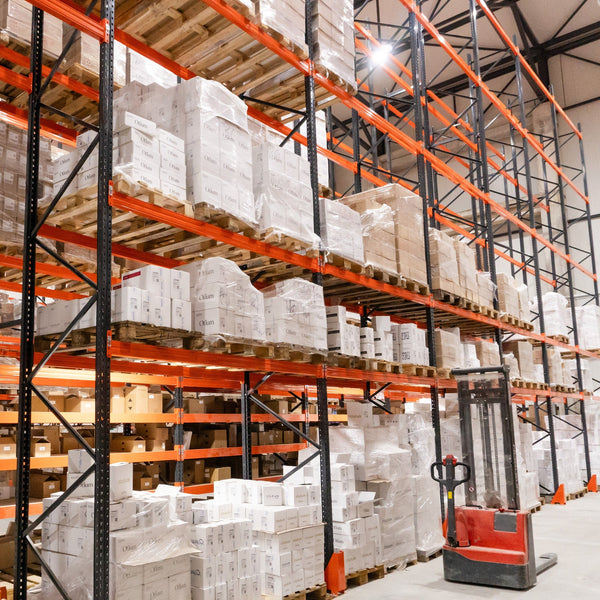
Lifting height is the second critical factor and one of the most frequent sources of errors. There are three distinct heights you need to know before any discussion with a supplier:
- Free lift height — how high the forklift can lift without the mast extending in height. Critical if you work in spaces with low ceilings or use freight elevators
- Maximum lifting height — the maximum height the forks can reach. Must exceed the height of the last shelf level by at least 200 mm
- Total height of the mast extended — the total height of the machine with the mast fully extended. Must be below the ceiling height, with a minimum 300 mm reserve for maneuvers
| Mast type | Lifting height | Free lift | Suitable for |
|---|---|---|---|
| Duplex standard | up to 3,500 mm | 150 mm | Warehouses with a single level of shelves |
| Triplex standard | 3,500 – 6,000 mm | 150 mm | Medium shelves, minimum 6.5m ceiling |
| Triplex full-free | 4,500 – 7,500 mm | 1,500 – 1,600 mm | Elevators, low ceilings, high shelves |
If your warehouse has freight elevators or ceilings under 4.5m, a triplex full-free mast is almost always the right choice — even if you pay €1,500–€2,500 more than a standard triplex.
Step 3 — Calculate the working aisle width
This is the criterion that most quickly eliminates incompatible options. Each forklift has a turning radius specified by the manufacturer — but the minimum working aisle width is 400–600 mm greater than the turning radius, because it includes the length of the pallet being handled.
Simple formula: required aisle width = forklift turning radius + pallet length (1,200 mm standard) + 200 mm reserve
| Equipment type | Turning radius | Minimum recommended aisle |
|---|---|---|
| Pallet truck with mast 1.5T | 1,300 – 1,485 mm | 1,800 – 2,200 mm |
| Electric forklift 1.5T – 2T | 1,600 – 1,800 mm | 2,800 – 3,200 mm |
| Electric forklift 2.5T – 3T | 1,900 – 2,200 mm | 3,300 – 3,800 mm |
| Reach truck | 1,400 – 1,600 mm | 2,300 – 2,700 mm |
If your aisles are under 2.8m and you cannot or do not want to reconfigure the shelves, a classic electric counterbalanced forklift will not work efficiently. Alternatives are pallet trucks with masts, reach trucks, or narrow-aisle forklifts — all available from HandlerKraft.
Step 4 — Evaluate intensity and work schedule
A technically correct forklift chosen incorrectly for the intensity of use will generate maintenance costs 3–4 times higher than normal. Classify your operation into one of three categories:
- Light use — under 4 hours/day of active lifting, single shift, maximum 1,000 cycles/year. Entry and mid-range models are sufficient. Standard lead-acid battery works without problems
- Medium use — 4–6 hours/day, one intensive shift or two partial shifts, 1,000–2,000 cycles/year. Choose industrial models with reinforced structure. Consider Li-ion if you do two shifts
- Intensive use — over 6 hours/day of active lifting, two full shifts, over 2,500 cycles/year. Industrial or heavy-duty models are mandatory. Li-ion is the only financially rational choice. Plan an annual service contract from day one
An entry-level forklift used intensively will require major overhaul in 18–24 months instead of 5 years. The cost difference: €8,000–€15,000 in repairs versus €5,000–€7,000 invested additionally at purchase for the correct model.
Step 5 — Indoor, outdoor, or mixed?
The working surface determines the type of tires and in some cases the type of engine. This is an irreversible decision unless you are willing to change the complete set of tires later.
- Exclusively indoor, flat concrete floor — solid (cushion) tires. Smaller turning radius, lower cost, ideal for warehouses with uniform pavement. Does not work outdoors or on irregular surfaces
- Mixed indoor and outdoor on asphalt pavement — pneumatic solid (superelastic) tires. The correct compromise for 70% of warehouses with asphalted yards
- Outdoor on uneven terrain or degraded pavement — pneumatic air tires or diesel/LPG forklift. An electric forklift is not recommended on surfaces with irregularities over 3 cm or slopes greater than 10–12%
Step 6 — Total budget, not just the purchase price
Once you have answered steps 1–5, you have the complete technical profile of the equipment you need. Now build the real budget, not the catalog price:
- Forklift price with necessary options — side-shifter, fork positioner, full-free mast if applicable
- Reserve battery if you work two shifts — add €1,800–€3,500
- Charger if not included in the package — add €400–€900
- First annual service contract — €400–€800, mandatory to maintain warranty
- Operator training — €150–€300, immediately recouped by reducing accidents and premature wear
Checklist before signing the order
Use this list as a final filter before any purchase decision:
- Have I measured the exact width of the narrowest aisle in the warehouse?
- Have I checked the ceiling height at the lowest point of the warehouse?
- Do I know the exact weight of the heaviest regularly handled pallet?
- Have I confirmed that the lifting height covers the last shelf level + 200mm?
- Have I chosen the correct type of tires for my working surface?
- Have I budgeted for a reserve battery if I work two shifts?
- Have I included the cost of annual service in the total calculation?
- Have I checked that the supplier has spare parts available in Moldova for the chosen model?
If you cannot answer any of these questions with certainty, call the HandlerKraft team at +373 22 788-907 before purchasing. A 20-minute consultation can prevent a €15,000 mistake.